
Is India’s Pet Food Market Really Worth USD 4.6 Billion?
India’s pet food market is growing fast, but is the USD 4.6 billion figure the real size of packaged pet food in India? Here’s a practical reality check.
S.A Anthony
5/4/20267 min read
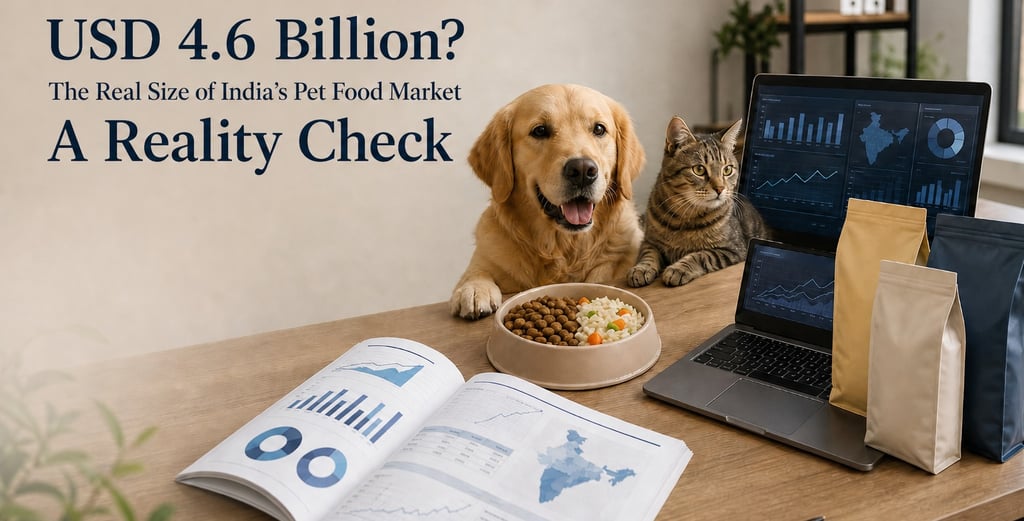
Is India’s Pet Food Market Really Worth USD 4.6 Billion?
One way of looking at the above question is to look at an actual case scenario of Pet owners. Take for example, the Guptas, a joint family home in Delhi, where they have two dogs — Rummy, a 6-year-old Pug, and Coco, a 2-year-old Shih Tzu. The dogs are treated like family members and have kids and grand parents fussing over them non-stop. Their vaccinations are done on time. Grooming appointments are not missed. The family knows their vet by name.
But when it comes to food, Rummy and Coco do not eat packaged pet food as their main meal.
The family is vegetarian. Fresh food is cooked every day for everyone in the house, including the dogs. Their meals usually include rice, curd, vegetables, paneer, roti, and vet-suggested additions when needed.
There is a packet of dog food at home, but mostly for convenience — travel, busy days, or moments when someone feels the dogs need “something extra.”
From an industry point of view, Rummy and Coco are part of India’s growing pet population.
But from a packaged pet food point of view, they are not full monthly consumers of complete pet food.
And this is where the gap begins: the gap between pets counted in a report and pets actually eating packaged meals every day.
The Ministry of Food Processing Industries’ pet food sector profile refers to India’s pet food market being valued at around USD 2.4 billion in 2024, with a projection of USD 4.6 billion by 2033. The report connects this growth to rising pet adoption, urban households, disposable incomes, pet humanisation, and increasing awareness around pet health and nutrition.
USD 4.6 billion.
58 Million pets.
8 % Average CAGR growth.
The Ministry of Food Processing Industries’ pet food sector profile refers to India’s pet food market being valued at around USD 2.4 billion in 2024, with a projection of USD 4.6 billion by 2033.
The report connects this growth to rising pet adoption, urban households, disposable incomes, pet humanisation, and increasing awareness around pet health and nutrition. This is the number that naturally gets attention.
It sounds large.
It sounds exciting.
It sounds investor-friendly.
But this number needs interpretation.
A future projection of the pet food market does not automatically mean that India currently has a USD 4.6 billion packaged complete-meal food market.
There is a difference between:
1. Total pet food opportunity,
2. Packaged pet food
3. Complete meal food
4. Dog and cat food
5. Premium food
6. Treats, Supplements, Toppers & snacks.
When all of these get mixed together, the industry can appear much larger than the actual number of pet parents buying packaged complete meals every month.
The Headline Number: USD 4.6 Billion
The Report’s Own Retail Figures Tell a More Grounded Story
The same sector profile gives another set of numbers that are more useful for understanding the actual retail market.
According to the report, India’s pet food retail value sales were:
USD 245.4 million in 2018
USD 629.6 million in 2023
USD 730.1 million in 2024
Projected USD 1.26 billion by 2028
This is where the larger story becomes more nuanced.
The headline market projection talks about billions of dollars. But the retail value table suggests that the actual pet food retail category is much closer to the USD 700 million to USD 1 billion range today, depending on what is included.
This does not mean the larger number is wrong. It means the definition matters.
For a pet food brand, the question is not only:
“How big is the pet food industry?”
The better question is:
“How much of this market is actually complete meal food bought repeatedly by Indian pet parents?”
That is the number that matters for business planning, product launches, distribution, and marketing.
Pet Population Is Not the Same as Pet Food Consumption
Another number that gets quoted often is India’s pet population.
The sector profile estimates India’s total pet population at around 38.4 million in 2023, growing to around 58.7 million by 2028. Dogs dominate this base, growing from around 33.6 million in 2023 to a projected 51.5 million by 2028. Cats are also expected to grow from around 3.6 million in 2023 to around 5.7 million by 2028. Birds and fish remain much smaller categories in comparison.
But this number also needs careful reading.
These figures should be understood as owned or household pet population estimates, not stray or community dog and cat population figures.
Even within owned pets, the number does not directly convert into packaged food consumption.
A dog may live inside a home.
The family may buy packaged food occasionally.
The dog may even eat kibble sometimes.
But that does not mean the dog is eating packaged complete meals every day.
This is the biggest gap in how India’s pet food opportunity is often discussed.
India Is Still a Mixed-Feeding Market
A pet parent may say:
“Why should I give my dog packet food when we cook fresh food at home?”
Another may say:
“My vet told me to add kibble, but my dog only eats it when I mix it with curd rice.”
And another may say:
“We do not cook non-veg at home, so we are not comfortable keeping chicken-based dog food in the kitchen.”
These are not small objections. They explain why India cannot be read like a mature packaged pet food market.
In mature pet food markets, packaged food is often the default. In India, it is still one of many feeding options — with a large share of pet parents continuing to rely on home-cooked food, or a mix of home food and packaged kibble.
Many Indian dogs are fed home-cooked rice and chicken, rice and curd, roti and milk, eggs, vegetables, paneer, dal-based meals, home-cooked meat, or mixed meals where kibble is added only as one part of the bowl.
This is not only about price.
It is about trust.
It is about habit.
It is about family food culture.
It is about the belief that fresh food is better than processed food.
It is also about the availability of domestic help and affordable ingredients.
These behaviours directly shape the real size of the packaged pet food market in India.
For many Indian pet parents, feeding is emotional. It is not only nutritional.
Price-Led Food vs Premium Food
The sector profile also gives a useful clue about pricing.
It states that mass products account for around 70% of the market, while premium and specialised products form the smaller share. It also notes that dry food dominates, with around 89.6% share in 2024, largely because it is affordable, shelf-stable, and easy to store.
This reflects the reality of India.
There are broadly three pet food markets operating at the same time:
1. Price-led packaged food
This includes affordable dry food, bulk packs, entry-level branded food, and products bought mainly for convenience and price.
This is likely the largest packaged segment.
2. Mid-market packaged food
This includes regular branded dog and cat food bought by urban pet parents who want better nutrition but are still price-conscious.
This is where many Indian households shift after vet recommendation or after adopting a pet for the first time.
3. Premium and super-premium food
This includes veterinary diets, breed-specific food, imported brands, grain-free food, functional nutrition, fresh meals, and high-meat formulations.
This segment gets a lot of attention, but it is not the majority of the Indian market yet.
Premium food is growing, but it is still concentrated among urban, higher-income, more aware pet parents.
The Vegetarian Household Factor
India has another unique challenge: household food culture.
In many homes, the pet’s diet follows the food habits of the family. If the household is vegetarian, the dog may be fed vegetarian home food. In some cases, the family may avoid meat-based pet food inside the house entirely.
This does not mean there is no opportunity for packaged pet food. But it means the opportunity has to be understood differently.
For many Indian homes, the barrier is not just price.
It is also:
“Will this fit our household food culture?”
“Is this safe?”
“Is this too processed?”
“Is this non-veg?”
“Can I trust the ingredients?”
“Will my vet approve?”
This is why Indian pet food marketing cannot only talk about global-style premium nutrition. It has to address Indian feeding beliefs.
So What Is the Real Market Size?
A practical way to read the Indian pet food market is this:
The broad future market opportunity may be large.
The pet population is growing.
Packaged food adoption is increasing.
Premiumisation is real.
But the current complete-meal packaged food market is much smaller than the most exciting headline numbers.
Based on the report’s retail value table and other available estimates, India’s current packaged pet food market appears to be in the broad range of:
USD 0.5–1.0 billion today
When we remove treats, chews, supplements, toppers, and non-meal products, the complete meal food market is likely smaller:
Approximately USD 0.45–0.75 billion
Within that, premium and super-premium complete meals are likely a smaller share:
Approximately USD 0.15–0.25 billion
These are not official audited numbers. They are practical working estimates based on available market reports, retail value figures, and feeding behaviour patterns.
But they are more useful than blindly repeating the USD 4.6 billion headline.
What This Means for Pet Food Brands in India
For pet food brands, the opportunity is not just about selling to “58 million pets.”
The real opportunity is converting Indian pet parents through stages:
From home-cooked only
to mixed feeding
to Packaged food as part of the routine
to Complete packaged meals
to Premium or therapeutic nutrition
This means brands need different communication for different consumer groups. For a home-cooked feeder, the message cannot simply be:
“Buy premium kibble.”
It may need to be:
“Is your dog’s daily home food nutritionally complete?”
For a mixed feeder, the message may be:
“How much packaged food is enough to balance the meal?”
For a premium buyer, the message may be:
“Is your pet’s food matched to age, breed, activity level, and health needs?”
For a vegetarian household, the message may need to address:
protein, digestibility, vet guidance, and ingredient trust.
The Better Question for India’s Pet Food Industry
The Indian pet food story is not just:
“How many pets are there?”
The better question is:
“How many pets are eating packaged complete meals regularly?”
And even more importantly:
“How many pet parents are ready to shift from emotional feeding to nutritional feeding?”
That is where the real industry opportunity lies.
Email- info@baubaupetservices.com
© 2025. All rights reserved
Location
Indira Sahakar Nagar
No 3, Ground floor,
Nahur Road, Mulund West
Mumbai 400080
Hours
Monday to Saturday 10 AM - 6 PM
+91 93217 31654