
Why Winning the Premium Pet Food Market in India Means Defeating Royal Canin
A deep strategic analysis of Royal Canin India—covering veterinary influence, prescription diets, breeder networks, pricing power, product placement, and early mover advantage in the premium pet food segment.
S. A Anthony
4/27/20265 min read
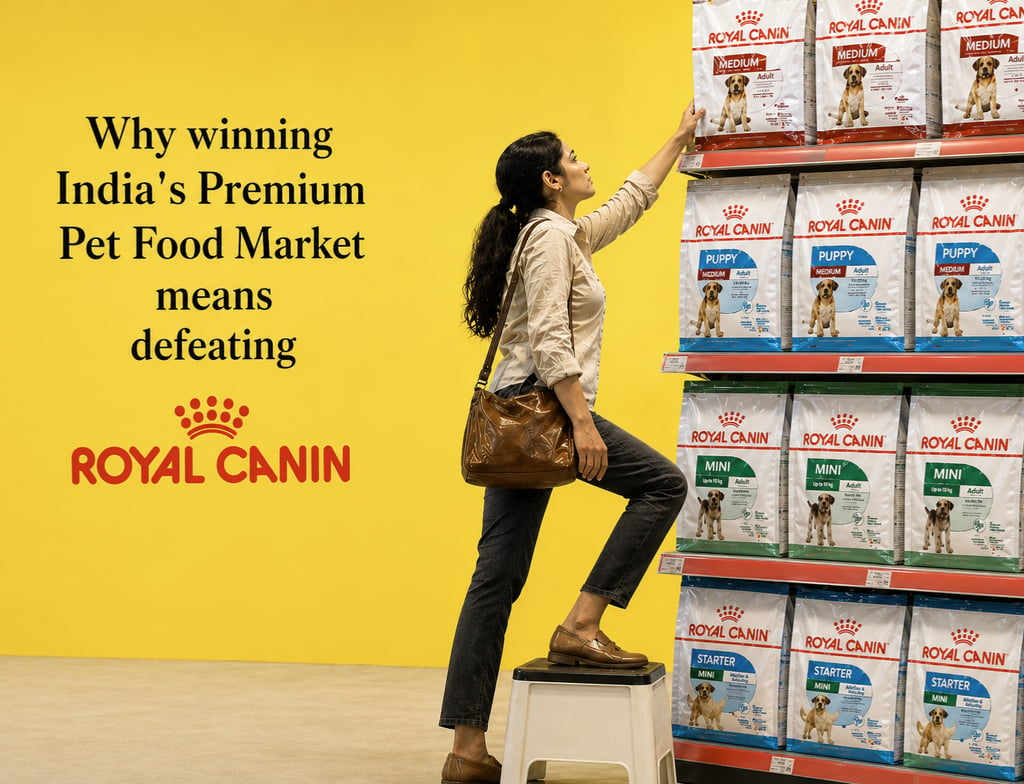
The Royal Canin dominance
I didn’t understand Royal Canin’s dominance through a campaign or a store shelf—I understood it inside a veterinary clinic.
I had taken my puppy in for a health concern in a Mumbai clinic. After the diagnosis, the Vet’s recommendation for the prescription diet was immediate: Royal Canin. To be sure, I visited another clinic. Different vet, different environment—but one of the options was still Royal Canin. This time, the Vet’s clinic environment made it even clearer. The shelves, the colours, the placement—it didn’t feel like a product being sold. It felt like part of the consultation itself.
That is when it becomes clear: Royal Canin is not just present in the market—it is embedded into the decision-making system.
Premium Pet Food in India: Growth Without Fragmentation
Over the last decade, India’s pet care market has expanded rapidly. Rising pet ownership, increasing urbanisation, and growing awareness around pet health have driven demand for higher-quality nutrition. The premium pet food segment, in particular, has seen a surge in:
Imported brands
Specialised formulas
Ingredient-led positioning
Digital-first challengers
Logically, more players should mean fragmented leadership.
But that hasn’t fully happened.
Despite increased competition, one brand continues to hold disproportionate influence in premium pet food decisions: Royal Canin.
Early Mover Advantage: Entering Before the Market Matured
Royal Canin’s success in India is partly rooted in timing.
The brand entered India in the early 2000s, with distribution through import partners at a time when the organised premium pet food market was still small and underdeveloped.
At that stage:
Pet food penetration itself was limited
Veterinary nutrition awareness was low
Premium segmentation was not clearly defined
Royal Canin entered not into a crowded premium market—but into a space where it could define what premium meant.
As the market expanded, Royal Canin did not have to chase growth. Growth came into the system it had already built.
This was not just timing—it was a model refined through years of global experience in veterinary-led nutrition.
A Different Starting Point: Nutrition as Health Support
Globally, Royal Canin began in 1968, founded by veterinarian Jean Cathary, based on the belief that nutrition could directly influence animal health.
Unlike many premium pet food brands that focus on ingredient quality or lifestyle positioning, Royal Canin focuses on precision nutrition:
Breed-specific diets
Age-stage formulas
Condition-linked nutrition
The consumer is not choosing the “best food.”
They are choosing the “right food.”
That global foundation shaped how Royal Canin approached markets like India—not as a mass brand, but as a specialised one.
The Core Strategy: Win the Recommender
Once that positioning was established, growth did not depend on advertising—it depended on influence.
Royal Canin built its strategy around:
Veterinary professionals
Breeders
Pet care experts
This created a powerful loop:
Vet recommends → Pet parent trusts → Store fulfils → Repeat purchase continues
And at the centre of that influence sits the most important stakeholder in this category—the veterinarian.
Veterinary Ecosystem: The Strongest Moat
Royal Canin’s deepest advantage lies in its integration with the veterinary ecosystem.
Its prescription diets are central to this.
These are not merely premium foods.
They are health condition-linked diets that can only be recommended by veterinary experts.
When a pet is diagnosed with:
Kidney issues
Gastrointestinal problems
Urinary conditions
Recovery needs
the purchase decision changes fundamentally.
The pet parent is no longer comparing brands.
They are following medical guidance.
In clinic-led diet recommendations, Royal Canin frequently appears among the first few options—reinforcing familiarity, trust, and repeat usage.
Product Placement: Where You See the Brand Matters
But influence does not work in isolation—its impact is strengthened by where the brand is seen.
A Royal Canin pack inside a veterinary clinic behaves very differently from one in a retail store.
Inside a clinic:
It sits within a medical context
It feels like part of treatment
It carries implicit endorsement
Inside a store:
It competes visually with other brands
It is evaluated more commercially
This is why even in premium pet stores, where newer brands are pushed, Royal Canin is always stocked. The demand is already created before the customer reaches the shelf.
Breeders: The First Point of Influence
While clinics shape decisions at the point of concern, another layer of influence begins much earlier.
Breeders often determine a pet’s first diet.
And the first diet often becomes the default diet.
Royal Canin has built strong engagement with breeders through structured programmes globally, offering:
Discounts and pricing support
Access to exclusive products
Loyalty and rewards systems
Educational resources
Larger breeder pack sizes reinforce this relationship further, allowing high-volume users to adopt the brand early and consistently.
Pricing Strategy: From Premium to Precision
When this early-stage influence is combined with long-term trust, it gives the brand unusual confidence in how it prices itself.
Royal Canin’s pricing reflects specificity, not just quality. For example,
Standard ranges sit around ₹700–₹900/kg
Breed-specific products exceed ₹1,000/kg
Senior and specialised diets command higher premiums
Instead of saying, “This is premium food,” the brand says:
“This is the right food for this specific pet.”
This reduces direct comparison and strengthens pricing power—especially in prescription diets, where alternatives are limited.
Breed-Specific Nutrition: A Category of One
If you type Labrador dog food on Google, many dog food brands recommendations would show up. However, if you type ’Poodle Dog food’ , three out of four recommendations would be Royal Canin. And this is their winning strategy. Nowhere is this precision-led approach more visible than in breed-specific nutrition. Royal Canin remains one of the few brands offering breed-level SKUs at scale in India. Other brands address size—but not specific breeds. This simplifies decision-making dramatically.
A Labrador owner sees Labrador food.
A Persian cat owner sees Persian food.
The product becomes the recommendation.
COVID: A Stress Test, Not a Collapse
With such deep structural advantages, it took a significant external disruption to challenge the system. COVID created temporary supply constraints, forcing some consumers to explore alternatives. This also led to the introduction and rampant upscaling of challenger pet food brands in the article.
This did cause them a dent in their market share, however the company quickly moved forwards to address the situation. Once availability stabilised, they ensure that,
Veterinary recommendations remained intact
Prescription diets retained relevance
Customers often returned
A case in point of how they have addressed the issue is the recent US-Iran military crisis. So, even when other multinationals are facing supply issues, Royal Canin has maintained surplus stocks as a policy post Covid and as of yet there is no dearth of their products in the market.
In the post covid era, RC does have its share of challenges, but that’s because the competitive landscape has changed for the brand.
Competition: Stronger Than Before, still way behind the RC System
The premium segment today includes brands like Purina, Farmina, Orijen, Acana, and Hill’s. There are the Hatcheries brands now turning towards the Pet food segment which include Godrej, Venkys and Licious to name a few. Then there are the bigger players entering the segment including Reliance, Nestle and others. Some of these are still testing the market and not yet have a serious offering except in a few sample markets. However there are existing players who are offering narratives which are different to RC.
Many competitors offer:
Strong ingredient narratives
Grain-free positioning
Better digital storytelling
However, most still compete on the visible layer.
Royal Canin’s strength lies in the invisible layer which includes -
Veterinary trust
Breeder influence
Prescription relevance
Structured distribution
Which is why competing with Royal Canin is less about matching the product—and more about rethinking the entire journey.
Where the Opportunity Lies
Royal Canin is not unbeatable—but it is difficult to displace.
A challenger must:
Influence pet parents earlier
Build strong digital communities
Simplify nutritional education
Create alternative trust pathways
The shift will not come from better packaging.
It will come from changing behaviour.
Conclusion: The Battle Is Not on the Shelf
Royal Canin’s leadership in India is built on a system. In a nutshell it includes the following -
Veterinary integration
Prescription diets
Breeder influence
Pricing confidence
Product specificity
This is why defeating Royal Canin is the real challenge in the premium pet food market. Because the brand is not just present at the point of purchase. It is present at the point of decision. And until that changes, the market will continue to revolve around it.
S. A Anthony
The author is a partner at Baubau Pet Services, a digital marketing agency specialising in the pet care industry. The opinions expressed are solely those of the author and are presented independently. This article has not been commissioned by, nor is it affiliated with, the brand mentioned.
Email- info@baubaupetservices.com
© 2025. All rights reserved
Location
Indira Sahakar Nagar
No 3, Ground floor,
Nahur Road, Mulund West
Mumbai 400080
Hours
Monday to Saturday 10 AM - 6 PM
+91 93217 31654