
Why Indian Pet Food Brands Must Build Their Own Pet Care Ecosystem
Indian pet food brands can no longer rely only on product, price, distribution, or ads. As pet parents become more informed, brands need ecosystems that educate, reassure, and build repeat trust. This article explains why every pet food brand’s ecosystem must be built around its own USP — whether price-led, premium, fresh, vegan, raw, or vet-led.
S.A Anthony
5/5/202612 min read
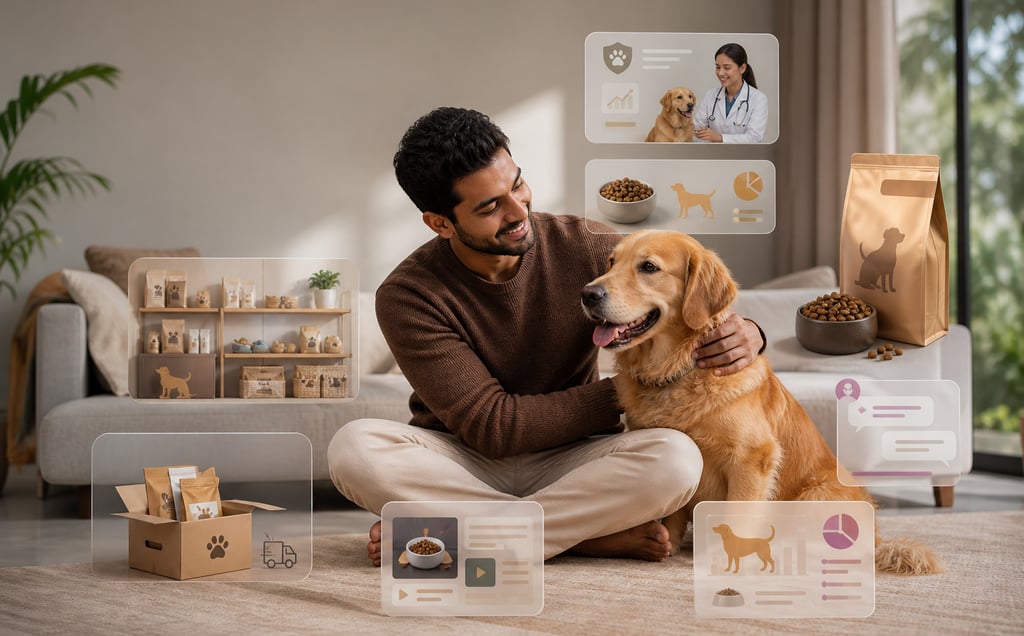
Why Indian Pet Food Brands Must Build Their Own Pet Care Ecosystem
Recently, a local Pet Food Brand CEO appeared in a social media ad eating directly from his own product packet to prove that the food was “human grade.” Another animal food startup founder claimed his brand had the best quality-to-price ratio in the market.
Both ads got attention.
Both created noise.
But attention is not the same as trust.
And noise is not the same as repeat Sales.
This is where many Indian pet food brands are getting stuck. They are trying to win the market with product claims, pricing, packaging and influencer posts. These things matter, but they are no longer enough.
The strongest pet food brands are not just selling food. They are building systems around how pet parents think, feed, trust, ask questions, and repeat purchase.
That system is what we call a Pet Care Ecosystem.
And in India, it is no longer a nice-to-have. It is becoming a strategic necessity.
The Old Pet Food Brand Model Is Breaking
For years, pet food brands in India focused on three things:
Product quality.
Distribution.
Price.
If the product moved from the shelf, if pet shops stocked it, and if vets recommended it, the system worked.
But that model is becoming weaker.
Indian pet parents are more informed now, sometimes over-informed. They are emotionally invested in their pets. They search online, ask vets, follow pet influencers, join WhatsApp groups, compare ingredients, and question brands.
They do not only want feeding instructions on the back of a pack. They want reassurance.
They want to know whether the food suits their dog’s age, breed, digestion, weight, coat, allergies, lifestyle, and budget. They want to know whether the brand understands their pet beyond the transaction.
Just like aware pet parents, there are other challenges that the Indian Pet Food industry faces at this time which impacts their performance - Read (link to Top 10 Challenges in the Pet Food Industry).
However, it is important to realise that the ecosystem for one brand would not be the same for another pet food brand.
But One Size Does Not Fit All
This is the most important point.
A Pet Care Ecosystem does not mean every brand should create the same Instagram page, vet videos, WhatsApp group, loyalty program, or feeding calculator.
A brand’s ecosystem must come from its USP.
It is not separate from the product. It is how the brand proves its product promise every day.
A price-led brand, a super-premium meat-first brand, a vegan brand, a therapeutic diet brand, and a fresh customised meal brand all need different ecosystems.
Here are a few examples of a few Pet Care Eco-systems that have been built by companies on the basis of their brand features and positioning.
1. Price-Led and Mass Pet Food Brands Need an Availability Ecosystem
A price-led pet food brand is built around affordability, availability, and everyday feeding.
Its customer is often a first-time pet parent, a budget-conscious household, a multi-dog home, a shelter feeder, or someone slowly shifting from home food to packaged food.
For this brand, the ecosystem should not sound too premium or scientific. It must make packaged feeding feel practical, safe, and accessible.
The ecosystem should include retailer education, regional language content, feeding quantity explainers, budget-based meal planning, starter packs, pet shop training, WhatsApp support, and simple guides on mixing home food with packaged food.
The success mantra is:
Be available, affordable, and understood.
This type of brand should not pretend to be super premium. It wins by becoming the easiest and most practical step into packaged pet nutrition.
2. Premium, Super-Premium and Meat-First Brands Need a Proof Ecosystem
Premium brands cannot only say “better ingredients” or “high quality.”
In India, premium pricing needs explanation. A pet parent will ask:
Why is this food twice the price?
Is the protein really better?
Will my dog digest it?
Is imported always better?
Will my vet agree?
For premium and super-premium brands, the ecosystem must prove the reason for the price.
This includes ingredient explainers, protein quality education, sourcing stories, digestibility content, breed and life-stage guides, vet-backed videos, transition guides, cost-per-day breakdowns, customer feeding diaries, and coat, stool, energy and weight tracking content.
The success mantra is:
Prove why you cost more.
For meat-first or ultra-premium brands, this proof has to go deeper. The brand must show why its sourcing, meat quality, format, and feeding philosophy are materially different.
Internationally, brands like ZIWI build their ecosystem around high-meat recipes, New Zealand sourcing, and air-dried formats. The lesson is simple: if ingredient quality is the USP, transparency must become the ecosystem.
Premium brands cannot depend only on aspirational packaging. They need a system that reduces hesitation before purchase and builds confidence after purchase.
3. Therapeutic, Vet-Led, Breed-Specific and Species-Specific Brands Need a Trust Ecosystem
Therapeutic, vet-led, breed-specific, and species-specific brands all depend on one major factor: trust.
These products are not bought like ordinary food. They are often chosen because of a vet recommendation, a breed requirement, a life-stage need, or a specific health concern such as kidney care, urinary health, obesity, skin issues, digestion, allergies, joints, or recovery.
For these brands, the ecosystem should include vet education material, condition-specific content, breed or species guides, disease explainers, feeding transition guidance, owner FAQs, clinic display material, reminder flows, lifecycle content, and follow-up support.
The success mantra is:
Build trust through education and compliance.
Royal Canin is a strong example here. Its ecosystem is built around precision nutrition, breed-specific formulas, and veterinary diets. The brand does not only sell food; it reinforces the idea that different pets need different nutrition.
For Indian brands in this space, the strongest asset will not be the loudest influencer campaign. It will be the trust loop between vet, pet parent, diagnosis, food, compliance, and repeat purchase.
4. Fresh, Customised and Personalised Meal Brands Need a Convenience Ecosystem
Fresh and customised pet food brands are not just selling food. They are selling a routine.
Their promise is:
“This food is made for your pet.”
That means the ecosystem must collect pet data and turn it into an ongoing relationship.
The ecosystem should include pet profile forms, age, breed, weight and activity-based plans, subscription reminders, storage guidance, meal transition guides, WhatsApp support, monthly feeding check-ins, AI-assisted meal suggestions, reorder nudges, and delivery communication.
The success mantra is:
Make personalisation convenient.
International brands like The Farmer’s Dog and Ollie have built their model around customised meal plans, pet profiles, portioning, and recurring delivery. Their ecosystem makes personalisation feel simple instead of complicated.
This is the biggest lesson for Indian fresh food brands. The product may sound ideal, but if ordering, storing, feeding, and repeating feels difficult, pet parents will drop off.
5. Vegan, Plant-Based, Raw and Freeze-Dried Brands Need a Credibility and Safety Ecosystem
Vegan, plant-based, raw, freeze-dried, and ancestral-style brands all face a similar challenge: they are built around a strong feeding belief, but pet parents may have doubts.
For vegan or plant-based brands, the questions are:
Is it complete?
Where does the protein come from?
Will my vet approve?
Is this nutrition or ideology?
For raw and freeze-dried brands, the questions are:
Is it safe?
How do I store it?
Can children touch it?
Will it smell?
How do I transition?
So the ecosystem must build credibility and reduce fear.
It should include nutritional adequacy explainers, vet-reviewed content, protein education, myth-busting, ethical storytelling, species-specific guidance, safe handling instructions, storage guides, transition plans, hygiene explainers, and product safety communication.
The success mantra is:
Make the belief safe, credible, and easy to follow.
Internationally, Wild Earth builds around plant-based nutrition and ethical positioning, while brands like Primal and Stella & Chewy’s build around raw or freeze-dried feeding with safety and handling education.
For India, this is especially important because household food culture strongly influences pet feeding. A vegan brand must make ethics nutritionally credible. A raw brand must make the format feel safe and simple.
Note - AI Should Become Part of the Ecosystem
AI can play an important role in pet food ecosystems, as long as it supports — not replaces — veterinary advice and nutrition expertise.
For Indian pet food brands, AI can help with budget-based food recommendations, breed and age-based feeding reminders, product selection quizzes, transition calculators, monthly feeding check-ins, content personalisation, pet parent segmentation, repeat purchase prediction, FAQ automation, and vet escalation prompts.
For example, a pet parent could enter their dog’s age, breed, weight, activity level, current food, budget, veg/non-veg preference, and digestive concerns.
The brand could then suggest a feeding pathway, relevant educational content, a starter pack, or a vet consultation prompt.
And this matters even more in India, because the feeding journey here is rarely straightforward.
Why This Matters More in India?
India is not a simple packaged pet food market.
It is shaped by home-cooked feeding, mixed feeding, price sensitivity, vet dependence, pet shop influence, breeder advice, Instagram content, WhatsApp groups, and cultural food practices.
This is exactly why an ecosystem matters.
A brand cannot assume that pet parents already understand complete nutrition, know how to transition from home food, see premium pricing as proof of quality, or will repeat purchase because of one viral ad.
In India, brands have to educate the market while selling to it.
That education, trust and continuity become the real competitive advantage.
A Pet Care Ecosystem is not a community, a content calendar, or just a loyalty program. It is the system that makes your brand useful before the first purchase and trustworthy after the tenth. For Indian pet food and nutrition brands, the question is no longer:
“Should we build an ecosystem?”
The better question is:
“What kind of ecosystem does our USP actually need?”
Recently a social media ad showed a local Pet Food Brand owner eating right out of the packet of his food brand to convince the audience that the food they made was human grade. Another Animal Food start up founder was busy guaranteeing that he had the best Pet Food in quality and price ratio to what was available in the market. Both the ads got views, engagement and made a lot of noise. However, whether these posts converted to product sales for their pet food brand is another matter. What they refuse to understand and what premium pet food brands that are not so visible in display and yet outsell these brands 3 to 1 is because they have bult their own Eco-system.
Lack of Pet Parent Eco-systems for Indian Pet Food players.
For decades, pet food brands in India focused on three things: product quality, distribution, and price. If a bag moved off shelves and vets recommended it, the system worked.
That system is fast disappearing.
In 2026, most Indian pet parents are informed (sometimes over-informed for their own good) , have disposable income and are emotionally invested in their pets. They don’t just buy food—they seek guidance, reassurance, and long-term answers about their pet’s health. And when brands fail to provide that continuity, pet parents look elsewhere.
This is why building a Pet Care Ecosystem is no longer a “nice-to-have” for pet food and nutrition brands—it is a strategic necessity.
The rise of Pet Food industry
Indian Pet Food brands have never had it easy. At first there were very few players in the market - dominated in the 90s and 2000s by just a few players like Pedigree and a few others. The market was mostly home-cooked meals and the few odd brands that were cheap imitations of Pedigree.
It was only post 2010 when the disposable income of pet parents rose significantly along with the increase in statistical number of dogs - that the market made any sense to enter. That is why historically you have had many companies and brands (Hills, Nestle are classic examples. ) enter into the market only to make a hasty retreat.
What is certain is that although the market is expanding and is of a certain size, so has the competition. Many international players have made their presence felt over the years and so have many Indian giants -(Reliance, Godrej and LIcious etc) , the battle is just heating up. So, though the pie of the Pet Food industry looks like it has gotten bigger, so have the players which makes the market extremely competitive.
It would be good to look at some of the real reasons as to Why there should be a growing need for a Pet Care Eco-system/
The ‘actual’ Pet Food industry size.
4.6 BILLION USD, 58 MILLION PETS, 8 PERCENT CAGR GROWTH RATE. These are the figures that interest most of the people. Most people get excited by quoting from an industry report published by the food ministry of India stating that the Pet Food market. These are the figures that the 2023 report quoted for the year 2028 which is very much around the horizon.
But is this really the Pet food industry size? The reader would be best advised to check the real figures (Link - read ‘is the pet food industry really worth 4.6 Billion USD- a reality check)
Challenges faced in the pet food industry
The Imported FMPF challenge - Fast Moving Pet Foods
FMPF’s are the first you would notice at any pet food brand. FMPF - read Fast Moving Pet Food brands. They would have decent-ish packaging with the picture of a dog or a cat depending on which species the food is being marketed to - would have instructions written in two languages - English and a foreign language - either Asian or at times an Arabic script. The instructions on the ingredients will have some details about meat and other by-products that could be called vague at best. However, the one thing they would all have in common - Cheap pricing. In some cases its almost half of less than that of any premium brand. These bunch of FMPF brands are literally the ‘Bread and butter’ of the Pet shops.
They are available even at Tier 2 and Tier 3 pet shops or even regular bakeries and are sold to pet owners looking to basically just feed their dog at a cheap price. When Indian pet food brands look to compete with such brands on the basis of just price, they lag behind by fat. This is where the absence of a eco-system that is built around distribution and pet parent education along with their brands positioning could really help these brands.
How Multinational Pet Food Brands play the game.
The mars group products be it the food in the right price range - Pedigree or let it be Royal Canin which was premium pet food - they were marketed right - to do that they followed their international guidelines and invested in these very systems. That is why you would get a Pedigree at a local Pan-tapri , also why certain vets will always recommend RC to you. That is the power of building and maintaining your own Pet Systems.
A few Indian Pet food companies like Drools have understood this and are busy making the right kind of investments to create their own eco-systems for their target customers. However, a majority of the Indian Pet Food brands especially those who aim for the premium segment are still are following the old model to market their products.
You can learn more about this by looking at the RC model - Read https://www.baubaupetservices.com/why-winning-the-premium-pet-food-market-in-india-means-defeating-royal-canin
The Shift: From Product Brands to Care Partners
In mature global markets, leading pet food brands stopped positioning themselves as manufacturers years ago. They evolved into care partners—brands that support the pet parent across the entire lifecycle, not just at the point of purchase.
India is now at that same inflection point.
Pet parents no longer want:
Just feeding guidelines on packaging
One-way advertising
Generic nutritional claims
They want:
Ongoing education
Preventive care insights
Brand-backed reassurance
A sense of belonging and continuity
This shift fundamentally changes how pet food brands must think about growth.
Why the Indian Market Makes Ecosystems Even More Critical
India is unique for three reasons:
Rapid pet parenting growth
First-generation pet parents are entering the ecosystem faster than ever, especially in urban India.High dependence on guidance
Unlike mature markets, Indian pet parents rely heavily on brands, vets, and digital content to make decisions.Fragmented advice landscape
Pet parents receive inputs from vets, influencers, breeders, WhatsApp groups, and social media—often contradictory.
In this environment, brands that build their own Pet Care Ecosystem become trusted anchors in an otherwise noisy landscape.
What a Pet Care Ecosystem Actually Means (Beyond a Community)
A Pet Care Ecosystem is not:
Just an Instagram page
A loyalty programme
A broadcast-only content strategy
A true ecosystem connects education, engagement, data, and continuity.
At its core, it enables brands to:
Stay connected with pet parents beyond the purchase
Educate consistently, not occasionally
Understand behaviour, concerns, and lifecycle needs
Build long-term trust rather than transactional loyalty
The Strategic Advantages for Pet Food & Nutrition Brands
1. Education Drives Better Nutrition Outcomes
Pet nutrition is not intuitive. Feeding errors, overfeeding, and misinformation are common.
An ecosystem allows brands to:
Explain nutrition in simple, contextual ways
Address breed, age, and lifestyle-specific needs
Correct myths without sounding promotional
Educated pet parents are more compliant—and more loyal.
2. Preventive Care Aligns Brand and Pet Interests
Preventive care is where trust is built.
When brands talk about:
Weight management
Digestive health
Dental care
Joint health
…they move from “selling food” to supporting long-term wellbeing.
This alignment is powerful, especially in nutrition-led categories.
3. Data Replaces Guesswork
A well-built ecosystem generates insight:
What pet parents worry about most
When they switch products
Where confusion exists
How needs change over time
This data helps brands:
Improve communication
Guide innovation
Support vets more effectively
Build sharper marketing strategies
4. Direct Relationships Reduce Dependency
Brands that rely only on:
Retail visibility
Vet recommendations
Paid media
Research - the use of AI in promoting specific diets and budget accomadative food choices for your pets. Make them a part of the pet food brands eco-system .
remain vulnerable.
A Pet Care Ecosystem allows brands to:
Build first-party relationships
Reduce over-dependence on single channels
Maintain continuity even during disruptions (as seen during COVID)
The Role of Digital Media in Building the Ecosystem
Digital media is the connective tissue of modern ecosystems.
It enables:
Discovery through search and social
Education through structured content
Engagement through two-way communication
Retention through reminders, follow-ups, and updates
When combined with CRM tools and local discovery platforms, digital media allows brands to support pet parents throughout the care journey—not just at checkout.
Indian Brands Are Already Moving in This Direction
Modern Indian pet food and animal health brands are increasingly:
Investing in education-led content
Building digital touchpoints beyond commerce
Collaborating with vets and experts
Thinking in terms of lifetime value, not single sales
Those who formalise this into a cohesive ecosystem strategy will lead the next decade of growth.
A Brand-Led Ecosystem Is Also an Industry Responsibility
In a market where misinformation spreads quickly, pet food brands play a critical role.
By building structured ecosystems, brands help:
Reduce confusion around nutrition
Support veterinary messaging
Encourage preventive care
Raise overall standards of pet health
This is not just good branding—it is good industry stewardship.
Closing Thought: Ecosystems Are the New Competitive Moat
In the next phase of India’s pet care growth, the strongest brands will not be those with the loudest advertising.
They will be the ones that:
Educate consistently
Communicate responsibly
Stay present across the pet’s life
Build trust that outlasts promotions
For Indian pet food and nutrition brands, the question is no longer whether to build a Pet Care Ecosystem—but how thoughtfully and how soon.
Email- info@baubaupetservices.com
© 2025. All rights reserved
Location
Indira Sahakar Nagar
No 3, Ground floor,
Nahur Road, Mulund West
Mumbai 400080
Hours
Monday to Saturday 10 AM - 6 PM
+91 93217 31654